Voice AI Agent
An outbound voice agent that places a real phone call, holds a context-aware conversation with whoever picks up, and returns a structured JSON outcome when the call ends. Provider-abstracted, 60 passing tests.
Muhammad SalmanI build production Agentic AI: LLM agents, RAG, and the document and audio pipelines around them, with the guardrails and evaluation that let them run in front of real users. Currently the sole engineer on a platform used daily by 200+ enterprise users.
An AI legal assistant built to make legal help accessible to every Pakistani citizen.
My role
I built the backend and the AI: the retrieval pipeline and the RAG chatbot grounded in Pakistani law, plus the document analysis. I also picked up the mobile app to help ship the client and to learn mobile development along the way.
Production AI, deep learning, and data-engineering work. Every card links to the code.
An outbound voice agent that places a real phone call, holds a context-aware conversation with whoever picks up, and returns a structured JSON outcome when the call ends. Provider-abstracted, 60 passing tests.
AI/MLFull-stack Generative AI support platform, built independently over seven months and 342 commits. RAG-grounded generation with output guardrails that validate content before it is sent, OAuth2 mailbox sync, and role-based access control across three roles.
An orchestrator decomposes a goal and routes it to five specialist agents with a review-and-revision loop. The agents use real tools, opening GitHub branches and pull requests, dispatching Slack messages and email campaigns, and posting inline review comments, not just generating text.
Siamese architectures (BiLSTM and CNN with attention) for detecting semantic similarity between legal clauses, trained on 295,000+ clause pairs across 395 categories without pre-trained transformers. Built with strict train/test separation so the metrics hold up.
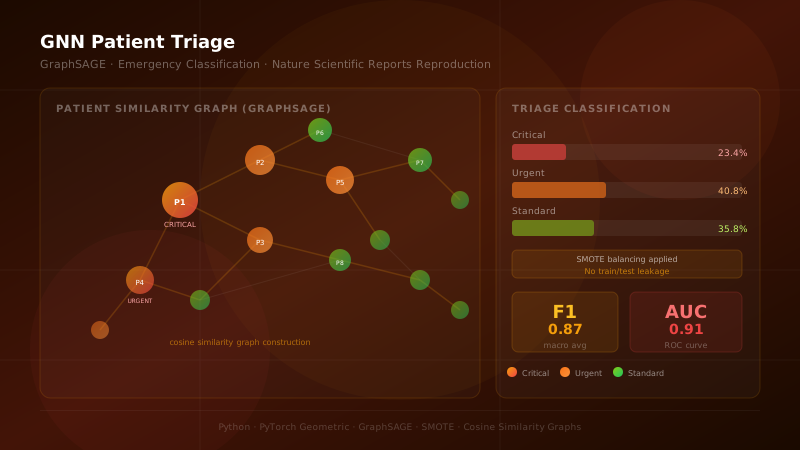
Reproduces a Nature Scientific Reports paper using GraphSAGE for emergency patient triage, with cosine-similarity graph construction, SMOTE balancing, and rigorous train/test leakage prevention.
AI/MLReads a job description from a URL, extracts the required skills, matches them against portfolio projects in a vector store, and drafts a tailored cold email through a Streamlit UI.
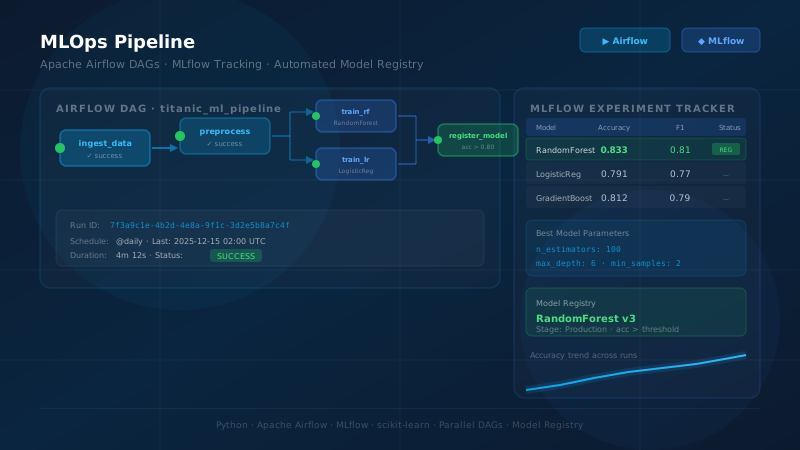
End-to-end MLOps pipeline with Airflow DAGs for orchestration and MLflow for experiment tracking and a model registry. Parallel tasks, branching logic, and automated model registration on accuracy thresholds.
A seven-stage fraud-detection pipeline with a conditional deployment gate: class weighting against SMOTE for severe imbalance, cost-sensitive learning, SHAP explainability, Prometheus and Grafana monitoring, and drift-driven retraining.
Data SciencePredicts electricity demand with preprocessing, clustering, and forecasting models, paired with an interactive React dashboard for data-driven energy management.
Data EngineeringA near real-time data warehouse analyzing METRO store purchasing behavior. Implements the MESHJOIN algorithm for efficient stream-relation joins, with a star schema and OLAP queries for revenue and product-affinity insights.
A search engine over large-scale data using Hadoop MapReduce for distributed indexing, plus a notebook path for smaller-scale preprocessing, vocabulary generation, and similarity scoring.
Streams preprocessed JSON through Kafka, then applies Apriori, PCY, and SON frequent-itemset algorithms on the consumer side, storing results in MongoDB.
AI/MLRecommends similar songs from 100 GB of the FMA audio archive using extracted audio features, with lyrics extraction via speech recognition and a web interface for playback.
VisualizationAn interactive TB data visualization platform with timelines, treemaps, and geographic maps, featuring tooltips, zoom, and hierarchical drill-down navigation.
Most of what I build is production Agentic AI: LLM agents, RAG, and the document and audio pipelines around them, with the guardrails and evaluation that let them run in front of real users. I am currently the sole engineer and technical owner of a platform used daily by 200+ enterprise users. The work I am proudest of is rarely the model itself; it is the deterministic check that catches what the model gets wrong, or the pipeline that turned a two-hour manual task into fifteen minutes.
Intrusion-detection papers routinely report 99%+ accuracy, usually from a single train-test split with accuracy as the only metric. We took one such CNN-LSTM/Transformer system on the InSDN dataset and asked whether that number survives a fair evaluation. It does not. With stratified 5-fold cross-validation, recursive feature elimination validated with SHAP, and imbalance-aware loss, the honest figure is 81.6% accuracy, swinging from 73.8% to 84.9% across folds. The 99% was not a better model, it was a measurement artifact. The point of the paper is that evaluation rigor and interpretability matter more than a headline metric when a model is meant to run in a real security setting.
The Insolvency Group
United Kingdom
Anviro
Islamabad, Pakistan
Google Developer Groups on Campus, FAST
Islamabad, Pakistan
AIM Lab
Islamabad, Pakistan
FAST National University of Computer and Emerging Sciences
Ranked 134th of 2000+ teams at the ICPC Asia regional programming contest.
LangChain for LLM Application Development
DeepLearning.AI · Dec 2024
Supervised Machine Learning: Regression and Classification
DeepLearning.AI · Jun 2024
Introduction to AWS
DataCamp · Jun 2024
Harnessing the Power of Data with Power BI
Microsoft · Mar 2024
Excel Business Intelligence: Power Pivot, DAX and Data Modeling
LinkedIn · Aug 2024
Pandas
Kaggle · Jun 2023
The tools I reach for across AI engineering, backends, and data. Grouped by where they sit in a real project.
How I got here
The curiosity that had me editing webpages at thirteen is the same one that now makes me test whether a system really works before trusting what it reports. The medium changed. The instinct did not.
The first thing I owned that made me wonder how the thing in my hands actually worked. Resident Evil and Final Fantasy pulled me in; the machine behind them kept me there.
By thirteen I was rewriting webpages in the browser's inspect panel just to see what would move, then building a small Roblox game so I could set the rules instead of only reading them. Take it apart, understand it, make it do something.
The years in between were a lot of small scripts and half-finished games. That is how Python and C++ stopped being things I could read and became things I could think in.
I started my degree the same semester ChatGPT shipped. The timing was luck. Staying up building with it every week since was not, and it is what turned coursework into a habit of shipping.
I published a paper on evaluation in intrusion detection: the unglamorous discipline of proving a model is as good as it claims before anyone relies on it. It is the same care I bring to systems that go in front of real users.
Two internships, an ICPC regional rank of 134 out of 2000+, and an AI engineering role before I finished my degree. Next, I want to do that with a team in the UK, on-site.
Open to new roles
If you are working on AI that has to do a real job, not just demo well, I would be glad to talk. The fastest way to reach me is email.
Based in Islamabad, Pakistan